
Esensja (PL) 16-02-2024
 Esensja
Translation:
"European soul, American flair"
[Susanne Alt's "Royalty for Real" - review]
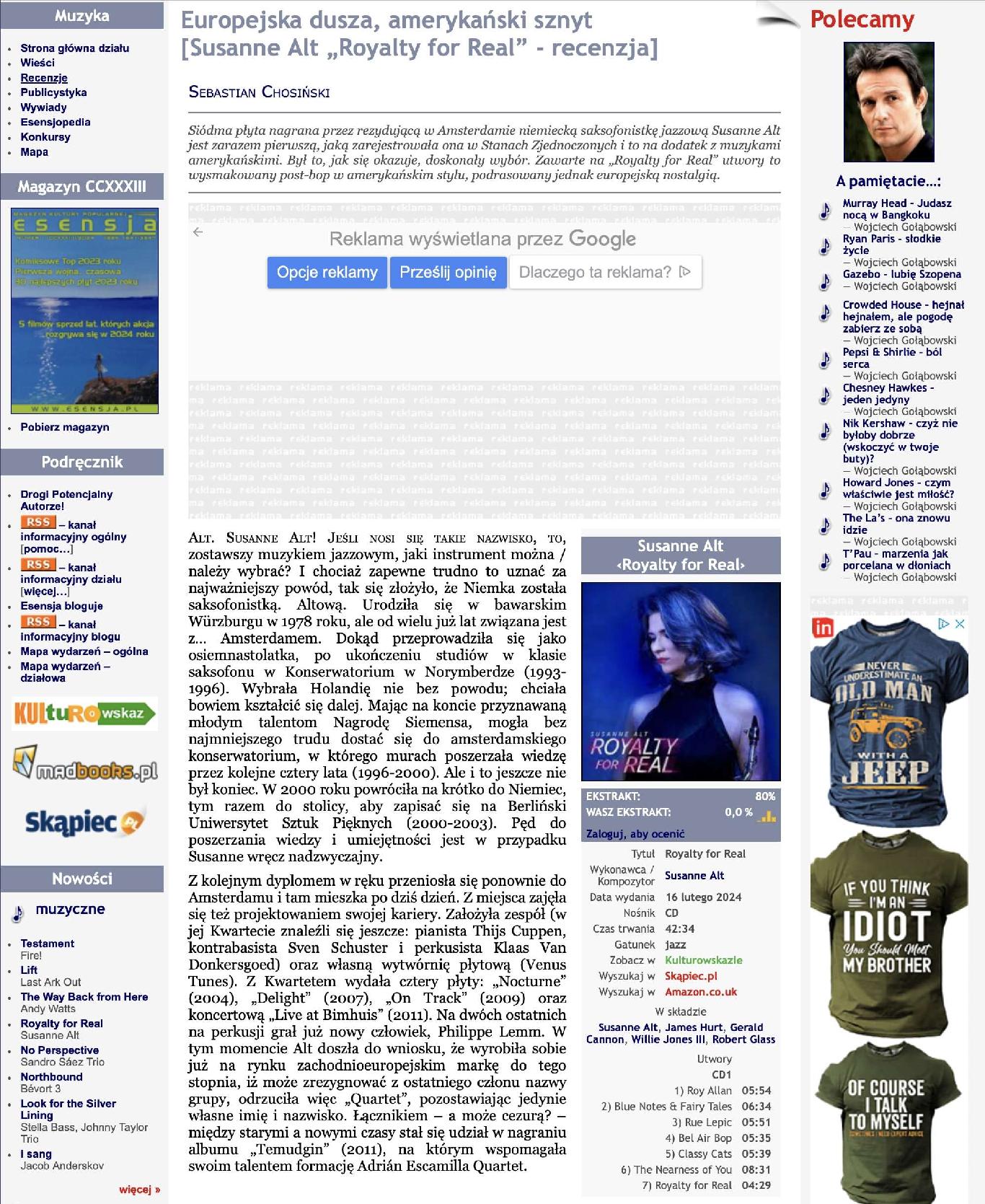
Seventh album recorded by the German jazz saxophonist Susanne Alt, based in Amsterdam, is also the first she recorded in the United States, with American musicians, no less. As it turns out, it was an excellent choice. The tracks on "Royalty for Real" are refined post-bop in an American style, but enhanced with European nostalgia.
Alt. Susanne Alt! If you carry such a name and become a jazz musician, what instrument can/should you choose? And though it's probably hard to consider it the most important reason, it so happened that the German chose to become a saxophonist. An alto saxophonist. She was born in Würzburg, Bavaria, in 1978, but for many years now, she has been associated with... Amsterdam. She moved there as an eighteen-year-old after completing her saxophone studies at the Conservatory in Nuremberg (1993-1996). She chose the Netherlands for a reason; she wanted to continue her education. With the Siemens Award for young talents to her credit, she could easily enroll in the Amsterdam Conservatory, where she expanded her knowledge for the next four years (1996-2000). But that wasn't the end. In 2000, she briefly returned to Germany, this time to the capital, to enroll at the Berlin University of Fine Arts (2000-2003). Susanne's drive to expand knowledge and skills is truly extraordinary.
With another diploma in hand, she moved back to Amsterdam and has been living there ever since. She immediately began designing her career. She formed a band (her Quartet included pianist Thijs Cuppen, bassist Sven Schuster, and drummer Klaas Van Donkersgoed) and her own record label (Venus Tunes). With the Quartet, she released four albums: "Nocturne" (2004), "Delight" (2007), "On Track" (2009), and the live album "Live at Bimhuis" (2011). On the last two, a new member, Philippe Lemm, played drums. At this point, Alt concluded that she had already established her brand in the Western European market to such an extent that she could dispense with the last part of the group's name. She dropped the "Quartet," leaving only her first name and last name. The transition – or perhaps the hiatus? – between old and new times was marked by her participation in the recording of the album "Temudgin" (2011), where she supported the Adrián Escamilla Quartet with her talent.
Later, she mainly operated on her own. She recorded the album "How to Kiss" (2012) with all the musicians from the Quartet (Cuppen, Schuster, Lemm), but she also invited several other artists to collaborate (including organist Thijs Van Leer from the legendary progressive group Focus). It was a new beginning. A new, expanded format. While working on "Saxify" (2016), about dozens of people – instrumentalists and vocalists – passed through the studio. The undertaking was admirable but also exhausting and costly. Perhaps for this reason, when preparing to record another album, Susanne decided to return to her earlier experiences and play in a chamber lineup. To avoid repeating patterns, this time she decided the album would be produced in New York and recorded with local jazz musicians. Thus, on February 15 and 16, 2022, she entered the EastSide Sound studio, a regular spot for John Zorn.
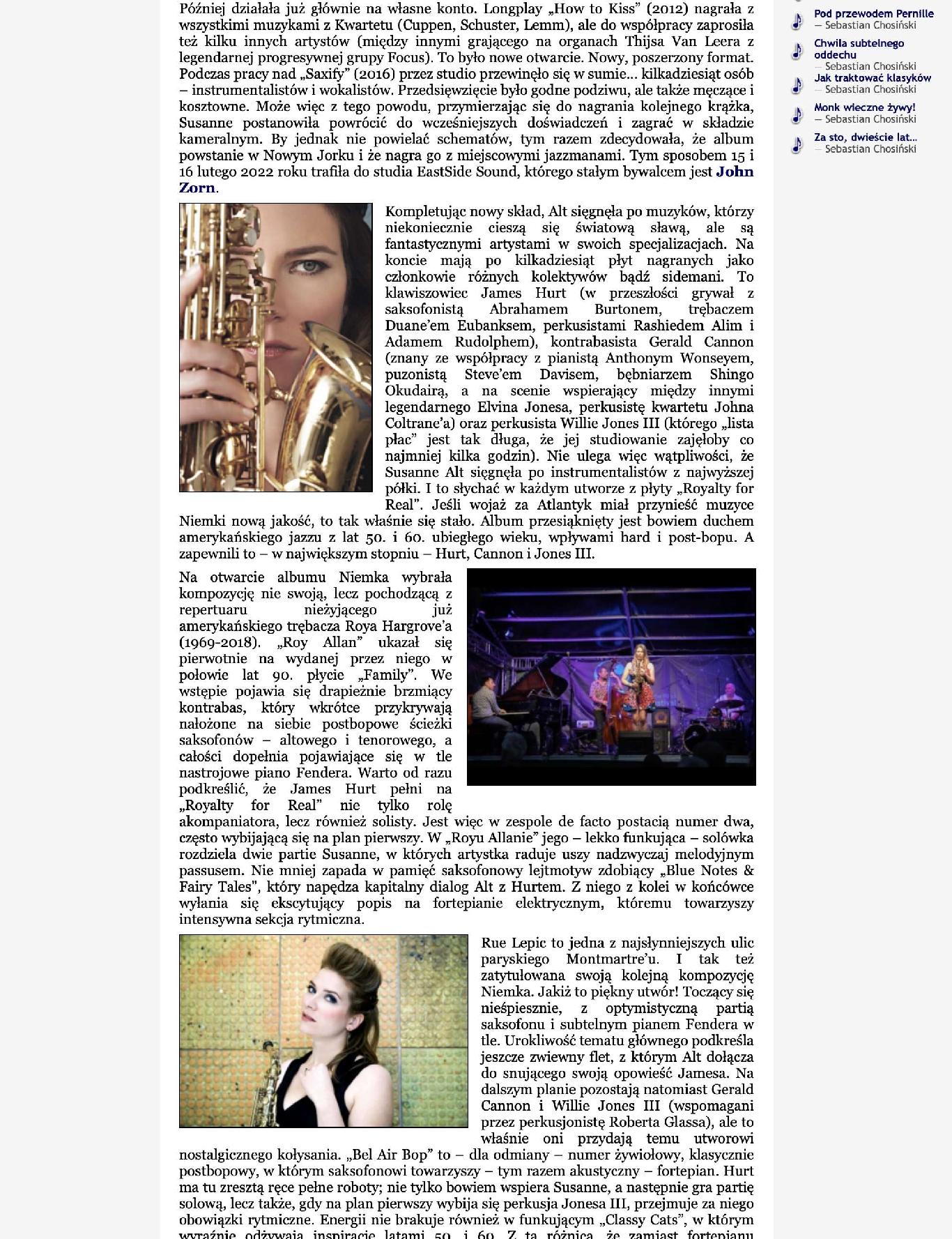
In assembling the new lineup, Alt reached for musicians who may not be globally famous but are fantastic artists in their specialties. They include keyboardist James Hurt (formerly played with saxophonist Abraham Burton, trumpeter Duane Eubanks, percussionists Rashied Alim, and Adam Rudolph), bassist Gerald Cannon (known for collaboration with pianist Anthony Wonsey, trombonist Steve Davis, drummer Shingo Okudaira, and on stage supporting, among others, the legendary Elvin Jones, the drummer of John Coltrane's quartet), and drummer Willie Jones III (whose "payroll" is so long that studying it would take at least a few hours). There is no doubt that Susanne Alt chose top-notch instrumentalists. And this is evident in every track on the "Royalty for Real" album. If the transatlantic journey was to bring a new quality to the German's music, that's exactly what happened. The album is soaked in the spirit of American jazz from the 50s and 60s, with influences of hard and post-bop. And it was provided, to the greatest extent, by Hurt, Cannon, and Jones III.
To open the album, the German chose a composition not hers but from the repertoire of the late American trumpeter Roy Hargrove (1969-2018). "Roy Allan" originally appeared on his mid-90s album "Family." The opening features a predatory-sounding double bass, soon covered by layered post-bop saxophone tracks – alto and tenor – and the background filled with the moody Fender piano. It's worth noting right away that James Hurt not only serves as an accompanist on "Royalty for Real" but also as a soloist. So, he is de facto the second character in the band, often standing out in the foreground. In "Roy Allan," his slightly funky solo separates two parts of Susanne, where the artist delights the ears with an exceptionally melodic passage. Equally memorable is the saxophone leitmotif adorning "Blue Notes & Fairy Tales," driving an excellent dialogue between Alt and Hurt. From this, in turn, emerges an exciting showcase on the electric piano, accompanied by an intense rhythm section.
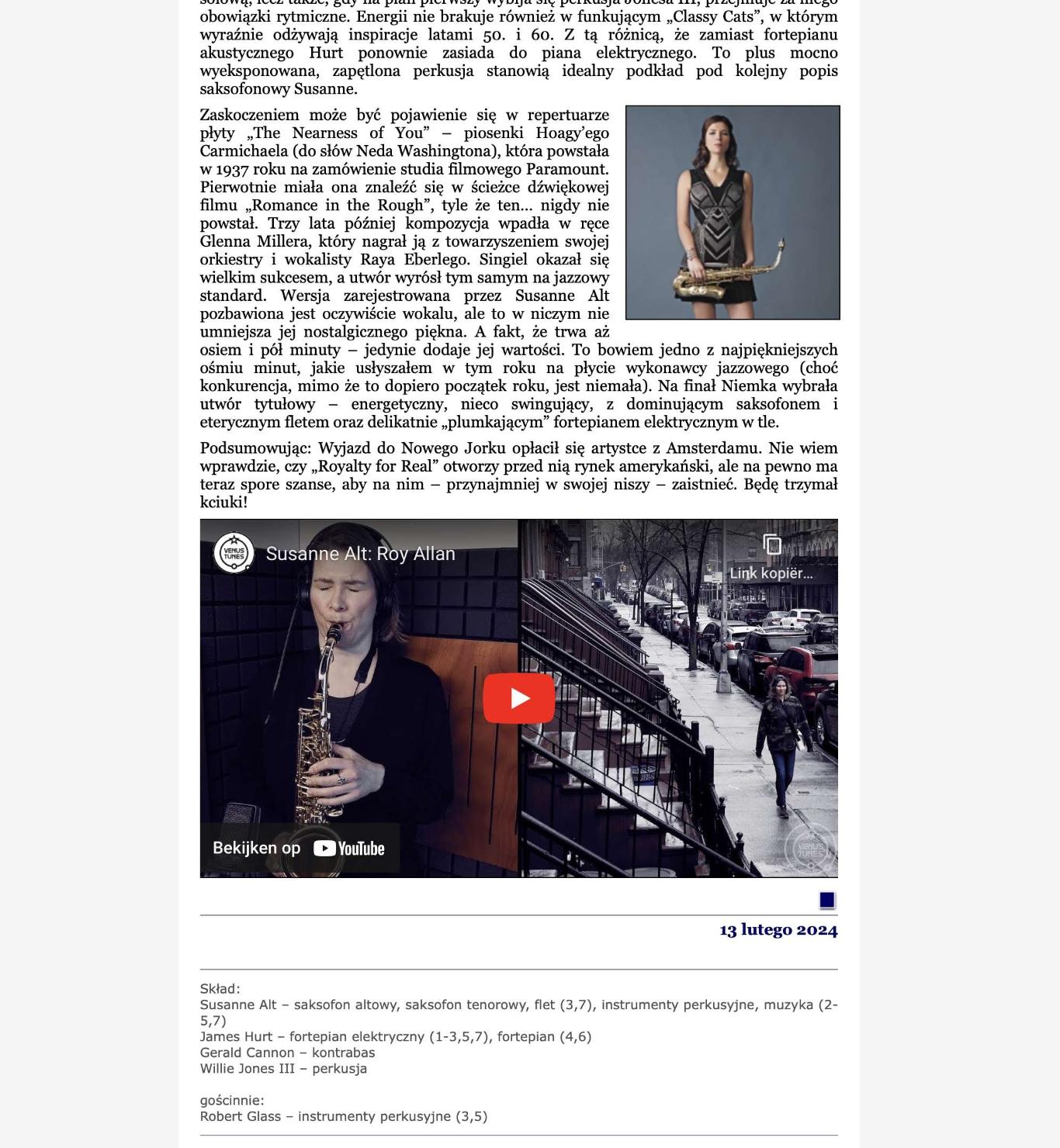
Rue Lepic is one of the most famous streets in Paris's Montmartre. And that's the title of her next composition. What a beautiful piece! It unfolds unhurriedly, with an optimistic saxophone line and subtle Fender piano in the background. The charm of the main theme is further emphasized by the airy flute, with which Alt joins James, who is weaving his story. In the background are Gerald Cannon and Willie Jones III (supported by percussionist Robert Glass), but it is they who give this piece its nostalgic sway. "Bel Air Bop," on the other hand, is a lively, classic post-bop number with a saxophone accompanied, this time, by an acoustic piano. Hurt, in this case, has his hands full; he not only supports Susanne and then plays a solo part, but also, when Jones III's drums take center stage, he takes over rhythmic duties for him. Energy is also not lacking in the funky "Classy Cats," where inspirations from the 50s and 60s are clearly revived. The difference is that instead of an acoustic piano, Hurt sits down again at the electric piano. The prominently featured, looped percussion provides the perfect backdrop for another saxophone showcase by Susanne.
A surprise may be the inclusion of Hoagy Carmichael's song "The Nearness of You" in the album's repertoire – with lyrics by Ned Washington – which was commissioned by Paramount Studios in 1937.Originally, it was supposed to be part of the soundtrack for the film "Romance in the Rough," but that... never came to be. Three years later, the composition fell into the hands of Glenn Miller, who recorded it with his orchestra and vocalist Ray Eberle. The single turned out to be a great success, and the piece thus grew into a jazz standard. The version recorded by Susanne Alt is, of course, devoid of vocals, but this in no way diminishes its nostalgic beauty. The fact that it lasts a whopping eight and a half minutes only adds to its value. It is indeed one of the most beautiful eight minutes I've heard this year on a jazz artist's album (although the competition, even though it's just the beginning of the year, is considerable).
For the finale, the German chose the title track – energetic, somewhat swinging, with a dominant saxophone and ethereal flute, and a delicately "plunking" electric piano in the background.
In summary: The trip to New York paid off for the artist from Amsterdam. I don't know if "Royalty for Real" will open the American market for her, but she certainly has a good chance to make a mark on it – at least in her niche. I'll be keeping my fingers crossed!
Lineup:
Susanne Alt – alto saxophone, tenor saxophone, flute (3,7), percussion instruments, music (2-5,7)
James Hurt – electric piano (1-3,5,7), piano (4,6)
Gerald Cannon – double bass
Willie Jones III – drums
Featuring:
Robert Glass – percussion instruments (3,5)
on 18/05/2024
back to top
TranslationSUSANNE ALT – Completely in the Groove At some point, she had enough. Not of jazz, but of the jazz business. Back then, Susanne Alt took a different direction. That was quite a turning point, the German saxophonist, who currently lives in Amsterdam, says today. An important one! After an excursion into funk/R&B, she immersed herself in the electro-dance world—performing as a DJ with saxophone. Meanwhile, jazz is allowed back into her life—but please, with soul-infused energy.By Arne Schumacher for Jazzthetik 07/08-2026, Germany Right now, I’m having an incredible amount of fun again. Susanne Alt does not necessarily want to talk about a comeback or a return to the jazz world. After all, she has continued to play jazz gigs. However, the impression of a recent, thoroughly fundamental change in her perspective is supported by the release of two albums. Ten years ago, Saxify was released, an album with which she confidently started a whole series of jazz productions. The funk plate of my dreams is how the Würzburg-born musician, who moved to the Netherlands at the age of 18 to study jazz, describes the album. Saxify featured legendary US funk and soul veterans. However, there had already been signs of a radical change—musically speaking. In her classically cast jazz quartet, Alt had always shown a sense of soul-jazz and a passion for grooves, which she says is in her blood. Parallel to my jazz education, I was always interested in other music: pop, funk, dance. When I brought my first band to an end, I was already appearing as a guest with house DJs. These electronic things were viewed with quite a bit of suspicion in jazz circles. For me, it felt entirely natural. Especially in a city like Amsterdam. There was always this vibrant club scene here, where instrumental electronic music was also played. That really appealed to me. This shift was preceded by a years-long struggle for recognition, gigs, appropriate payment, and ultimately, economic survival as a jazz musician. In 2003, after a three-year study phase in Berlin, she had returned to the Amstel River, bringing with her—besides her highly developed craftsmanship—an artistic maturity and an individual expression. And she knew she absolutely wanted to be independent. A year later, the saxophonist (who plays soprano as well as flute alongside alto) released her debut album on her own label, Venus Tunes. With each subsequent production, her career advanced. On the other hand, she had to realize that achieving a better status in the jazz world did not automatically translate into appropriate financial compensation for concerts. The frustration grew—in many respects. As a bandleader, always having to drag everyone along under the old model, and just trying to make it work, was extremely exhausting and ultimately really annoying. Looking back, she has to laugh, even when thinking about the sometimes lethargic band memebers. Even with all the pressure and stress, I was still in a relatively good position, despite the cultural-political conditions in the Netherlands, which have worsened since 2010. But I felt a musical stagnation. I just didn’t want to keep repeating myself. The transition with Saxify reshuffled the cards. After Alt was booked more and more as a soloist for DJ sets, people began asking her if she would like to DJ herself. She took the step. And she gradually established herself as a DJ, with her sax always a key part of it. It was just a breath of fresh air. Sometimes it’s healthy to do something else. I wanted to see how it would develop. Meanwhile, tracks from Saxify were making the rounds in remixes by respected club producers. To bring everything back to the stage, she founded her all-female trio Venus Tunes Live. Soon it became clear that all of this was also economically highly rewarding. Whether she missed jazz during those years? No, not really, she smiles. That changed slowly in the wake of the Corona crash. The result: a whole new series of compositions—and an incredibly well-cast studio production in February 2022 in New York City, featuring James Hurt (keys), Gerald Cannon (b), and Willie Jones III (dr). This session yielded enough material for two albums at once. Royalty for Real is an homage to trumpet player Roy Hargrove. With Dark Horse, she recently followed up with an album that emphasizes the groove side through a strong use of keyboards. Her alto sax sound is better than ever. You can hear that Susanne Alt feels completely comfortable in this context, which unites different aspects of her journey. She also speaks of a new focus. And she is once again leading a live band, a six-piece working band. Does she feel a new inner balance? I feel completely in motion right now! As you change, you see everything as an enrichment, because you stay active and grow. You look at things and think: What is my role in the grand scheme of things, what can I contribute? I don’t want to hear the endless complaining anymore. Part of this mindset includes her teaching activities; alongside sharing her broad experience at the University of Arts in Arnhem, she is involved in targeted cultural-political engagement. This includes strengthening the network of jazz communities to help jazz advance even in difficult times. Under the banner of a good groove! Current Albums:Susanne Alt: Dark Horse (Venus Tunes) - EsensjaTranslation:European soul, American flair[Susanne Alt's Royalty for Real - review]Seventh album recorded by the German jazz saxophonist Susanne Alt, based in Amsterdam, is also the first she recorded in the United States, with American musicians, no less. As it turns out, it was an excellent choice. The tracks on Royalty for Real are refined post-bop in an American style, but enhanced with European nostalgia.Alt. Susanne Alt! If you carry such a name and become a jazz musician, what instrument can/should you choose? And though it's probably hard to consider it the most important reason, it so happened that the German chose to become a saxophonist. An alto saxophonist. She was born in Würzburg, Bavaria, in 1978, but for many years now, she has been associated with... Amsterdam. She moved there as an eighteen-year-old after completing her saxophone studies at the Conservatory in Nuremberg (1993-1996). She chose the Netherlands for a reason; she wanted to continue her education. With the Siemens Award for young talents to her credit, she could easily enroll in the Amsterdam Conservatory, where she expanded her knowledge for the next four years (1996-2000). But that wasn't the end. In 2000, she briefly returned to Germany, this time to the capital, to enroll at the Berlin University of Fine Arts (2000-2003). Susanne's drive to expand knowledge and skills is truly extraordinary.With another diploma in hand, she moved back to Amsterdam and has been living there ever since. She immediately began designing her career. She formed a band (her Quartet included pianist Thijs Cuppen, bassist Sven Schuster, and drummer Klaas Van Donkersgoed) and her own record label (Venus Tunes). With the Quartet, she released four albums: Nocturne (2004), Delight (2007), On Track (2009), and the live album Live at Bimhuis (2011). On the last two, a new member, Philippe Lemm, played drums. At this point, Alt concluded that she had already established her brand in the Western European market to such an extent that she could dispense with the last part of the group's name. She dropped the Quartet, leaving only her first name and last name. The transition – or perhaps the hiatus? – between old and new times was marked by her participation in the recording of the album Temudgin (2011), where she supported the Adrián Escamilla Quartet with her talent.Later, she mainly operated on her own. She recorded the album How to Kiss (2012) with all the musicians from the Quartet (Cuppen, Schuster, Lemm), but she also invited several other artists to collaborate (including organist Thijs Van Leer from the legendary progressive group Focus). It was a new beginning. A new, expanded format. While working on Saxify (2016), about dozens of people – instrumentalists and vocalists – passed through the studio. The undertaking was admirable but also exhausting and costly. Perhaps for this reason, when preparing to record another album, Susanne decided to return to her earlier experiences and play in a chamber lineup. To avoid repeating patterns, this time she decided the album would be produced in New York and recorded with local jazz musicians. Thus, on February 15 and 16, 2022, she entered the EastSide Sound studio, a regular spot for John Zorn.In assembling the new lineup, Alt reached for musicians who may not be globally famous but are fantastic artists in their specialties. They include keyboardist James Hurt (formerly played with saxophonist Abraham Burton, trumpeter Duane Eubanks, percussionists Rashied Alim, and Adam Rudolph), bassist Gerald Cannon (known for collaboration with pianist Anthony Wonsey, trombonist Steve Davis, drummer Shingo Okudaira, and on stage supporting, among others, the legendary Elvin Jones, the drummer of John Coltrane's quartet), and drummer Willie Jones III (whose payroll is so long that studying it would take at least a few hours). There is no doubt that Susanne Alt chose top-notch instrumentalists. And this is evident in every track on the Royalty for Real album. If the transatlantic journey was to bring a new quality to the German's music, that's exactly what happened. The album is soaked in the spirit of American jazz from the 50s and 60s, with influences of hard and post-bop. And it was provided, to the greatest extent, by Hurt, Cannon, and Jones III.To open the album, the German chose a composition not hers but from the repertoire of the late American trumpeter Roy Hargrove (1969-2018). Roy Allan originally appeared on his mid-90s album Family. The opening features a predatory-sounding double bass, soon covered by layered post-bop saxophone tracks – alto and tenor – and the background filled with the moody Fender piano. It's worth noting right away that James Hurt not only serves as an accompanist on Royalty for Real but also as a soloist. So, he is de facto the second character in the band, often standing out in the foreground. In Roy Allan, his slightly funky solo separates two parts of Susanne, where the artist delights the ears with an exceptionally melodic passage. Equally memorable is the saxophone leitmotif adorning Blue Notes & Fairy Tales, driving an excellent dialogue between Alt and Hurt. From this, in turn, emerges an exciting showcase on the electric piano, accompanied by an intense rhythm section.Rue Lepic is one of the most famous streets in Paris's Montmartre. And that's the title of her next composition. What a beautiful piece! It unfolds unhurriedly, with an optimistic saxophone line and subtle Fender piano in the background. The charm of the main theme is further emphasized by the airy flute, with which Alt joins James, who is weaving his story. In the background are Gerald Cannon and Willie Jones III (supported by percussionist Robert Glass), but it is they who give this piece its nostalgic sway. Bel Air Bop, on the other hand, is a lively, classic post-bop number with a saxophone accompanied, this time, by an acoustic piano. Hurt, in this case, has his hands full; he not only supports Susanne and then plays a solo part, but also, when Jones III's drums take center stage, he takes over rhythmic duties for him. Energy is also not lacking in the funky Classy Cats, where inspirations from the 50s and 60s are clearly revived. The difference is that instead of an acoustic piano, Hurt sits down again at the electric piano. The prominently featured, looped percussion provides the perfect backdrop for another saxophone showcase by Susanne.A surprise may be the inclusion of Hoagy Carmichael's song The Nearness of You in the album's repertoire – with lyrics by Ned Washington – which was commissioned by Paramount Studios in 1937.Originally, it was supposed to be part of the soundtrack for the film Romance in the Rough, but that... never came to be. Three years later, the composition fell into the hands of Glenn Miller, who recorded it with his orchestra and vocalist Ray Eberle. The single turned out to be a great success, and the piece thus grew into a jazz standard. The version recorded by Susanne Alt is, of course, devoid of vocals, but this in no way diminishes its nostalgic beauty. The fact that it lasts a whopping eight and a half minutes only adds to its value. It is indeed one of the most beautiful eight minutes I've heard this year on a jazz artist's album (although the competition, even though it's just the beginning of the year, is considerable). For the finale, the German chose the title track – energetic, somewhat swinging, with a dominant saxophone and ethereal flute, and a delicately plunking electric piano in the background.In summary: The trip to New York paid off for the artist from Amsterdam. I don't know if Royalty for Real will open the American market for her, but she certainly has a good chance to make a mark on it – at least in her niche. I'll be keeping my fingers crossed!Lineup:Susanne Alt – alto saxophone, tenor saxophone, flute (3,7), percussion instruments, music (2-5,7)James Hurt – electric piano (1-3,5,7), piano (4,6)Gerald Cannon – double bassWillie Jones III – drumsFeaturing:Robert Glass – percussion instruments (3,5)