Ingenious administration idea from Dutch governement for the self-employed.
Being a freelance saxophone player in the Netherlands usually is fun, you get to play a lot of different music with different people. I am a very lucky person who can live from playing only. I like jazz, soul, funk, house music. I like to perform at festvals. in clubs, at official opening parties and also private parties like weddings, birthdays, corporate events as long as the music is good, the colleagues are good musicians/dj's and the payment is fair. I like to network, try to be a versatile and professional musician, embracing the different situation at every gig, "never a dull moment". Learning new things all the time, (try to) master old weaknesses and new exciting challenges.
Somehow the Dutch government doesn't see that removing a lot of subsidy was already a heavy burdon for the sector. After the end of subsidising jazz radio station Radio 6, jazz clubs and many festivals they seem to want to finish off the remaining musicians via a traditional weak point: paperwork. 1-0 for the government! The government seriously came up with the brilliant idea to let every musician send a contract in advance for every gig. Often gigs are booked last-minute. So apart from sending the invoice and check if it's paid, now we get an extra task to see if the contract is returned in time. This way, band shows become a paperwork inferno. I as a band leader would have to send a contract to the club organisation, each of the self-employed band members have to send a contract to me! Read this article (in Dutch). Maybe it's a better idea to charge musicians money for performing. I bet the administration is easier :-)
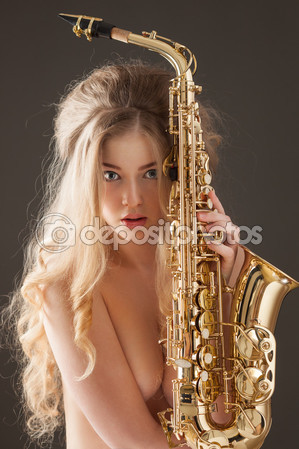
Or pay in natura. Look, the poor girl is having her mouthpiece upside down. Aawww.
And she doesn't have a clue whether to put her hands..
I have an idea. Maybe we can change the quantity of conservatories? Why educate so many young aspiring musicians and pretend that they get a diploma to be a professional musician? Even the conservatoria became more cautious in the despricption of the career perspectives than they used to: "A great many former students succeed in developing careers in the diverse music profession. They form their own chamber music groups, play in orchestras, perform with jazz groups, participate in the broad field of music education: teaching privately or at a music school, or leading workshops, they instigate and organize projects or have their own ensembles or choirs. Every effort is made to prepare students for the practical and business aspects of the music profession, a field which changes all the time." (Source: Conservatory of Amsterdam) So why educate so many? I guess the conservatory teachers have to eat, too :-)
This is a tune called Kalunga Dance, from my latest album Dark Horse, order it here or buy it at a concert, the next one is Brebl, Nijmegen 1 day after my birthday on 16th of April! Hope to see you there!In this performance, we featured percussionist/vocalist and world citizen Helene Jank. She lived and worked in Brazil for quite a while and I really think it's audible here. I love the way she and the band creates this moment of space within the concert and this is also why - I think - visiting concerts is important because then you get to experience the whole context of the concert. How is the program build up, how does the audience respond and what does music makes you feel. More info:Susanne Alt: sax, Matthijs Geerts and Ike van Bergen: keys, Thomas Pol: bass, Yoràn Vroom: drums, Helene Jank: percussion Performed at 16th of January 2026 at Bimhuis, Amsterdam, Recorded by Onno Prillwitz Filmed by Robert Glass and Albert Nooij. - Being a freelance saxophone player in the Netherlands usually is fun, you get to play a lot of different music with different people. I am a very lucky person who can live from playing only. I like jazz, soul, funk, house music. I like to perform at festvals. in clubs, at official opening parties and also private parties like weddings, birthdays, corporate events as long as the music is good, the colleagues are good musicians/dj's and the payment is fair. I like to network, try to be a versatile and professional musician, embracing the different situation at every gig, never a dull moment. Learning new things all the time, (try to) master old weaknesses and new exciting challenges. Somehow the Dutch government doesn't see that removing a lot of subsidy was already a heavy burdon for the sector. After the end of subsidising jazz radio station Radio 6, jazz clubs and many festivals they seem to want to finish off the remaining musicians via a traditional weak point: paperwork. 1-0 for the government! The government seriously came up with the brilliant idea to let every musician send a contract in advance for every gig. Often gigs are booked last-minute. So apart from sending the invoice and check if it's paid, now we get an extra task to see if the contract is returned in time. This way, band shows become a paperwork inferno. I as a band leader would have to send a contract to the club organisation, each of the self-employed band members have to send a contract to me! Read this article (in Dutch).Maybe it's a better idea to charge musicians money for performing. I bet the administration is easier :-) Or pay in natura. Look, the poor girl is having her mouthpiece upside down. Aawww. And she doesn't have a clue whether to put her hands..I have an idea.Maybe we can change the quantity of conservatories? Why educate so many young aspiring musicians and pretend that they get a diploma to be a professional musician? Even the conservatoria became more cautious in the despricption of the career perspectives than they used to:A great many former students succeed in developing careers in the diverse music profession. They form their own chamber music groups, play in orchestras, perform with jazz groups, participate in the broad field of music education: teaching privately or at a music school, or leading workshops, they instigate and organize projects or have their own ensembles or choirs. Every effort is made to prepare students for the practical and business aspects of the music profession, a field which changes all the time. (Source: Conservatory of Amsterdam) So why educate so many? I guess the conservatory teachers have to eat, too :-)