
Esensja (Poland), January 2026

 Read more
 English translation:
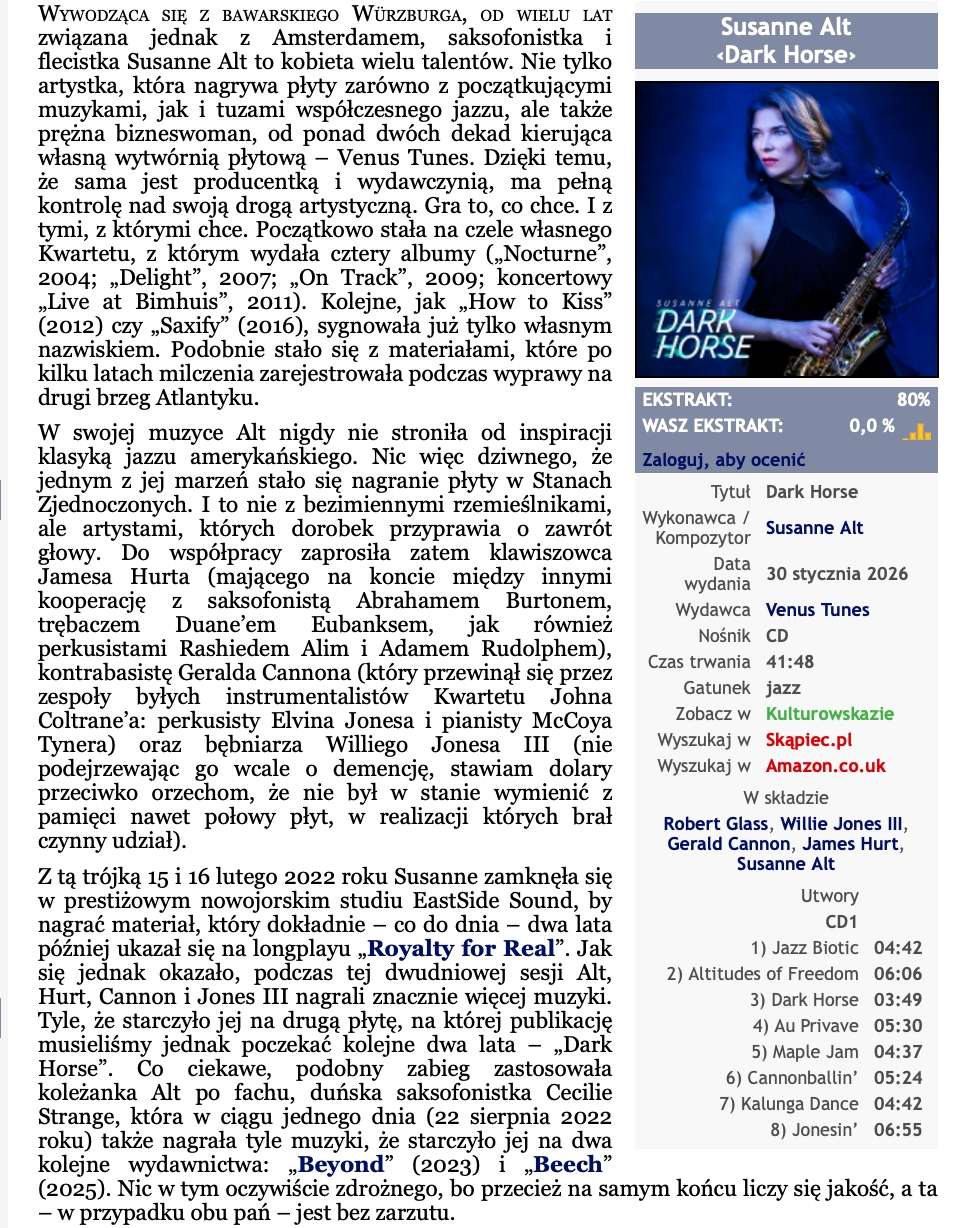
Susanne Alt was born in Bavaria, but chose Holland as her adopted homeland. He lives in Amsterdam, but also dreams of a career in the United States. In 2022, she went there to record material with New York jazzmen, which turned out to be enough for two full-length albums. "Royalty for Real" was released two years ago, "Dark Horse" is now being published.
A native of Würzburg in Bavaria, but has been associated with Amsterdam for many years, saxophonist and flutist Susanne Alt is a woman of many talents. Not only an artist who records albums with both aspiring musicians and modern jazz aces, but also a thriving businesswoman who has been running her own record label - Venus Tunes for over two decades. Thanks to the fact that she is a producer and publisher herself, she has full control over her artistic path. He plays what he wants. And with the ones he wants. Initially, she headed her own Quartet, with which she released four albums ("Nocturne", 2004; "Delight", 2007; "On Track", 2009; concert "Live at Bimhuis", 2011). Others, like "How to Kiss" (2012) or "Saxify" (2016), she signed only with her own name. The same happened with the materials that she recorded after several years of silence during the expedition to the other side of the Atlantic.
In her music, Alt never shied away from inspiration from the classics of American jazz. No wonder, then, that one of her dreams was to record an album in the United States. And not with unnamed craftsmen, but artists whose achievements are dizzying. She therefore invited keyboardist James Hurt (who has, among others, a collaboration with saxophonist Abraham Burton, trumpeter Duane Eubanks, as well as drummers Rashied Ali and Adam Rudolph), double bassist Gerald Cannon (who scrolled through the bands of former Quartet instrumentalists John Coltrane: drummer Elvin Jones and pianist McCoy Tyner) and drummer Willie Jones III (not suspecting him of dementia at all, I bet the dollars against nuts that he was not able to mention even half of the albums in which he took an active part).
With these three, on February 15 and 16, 2022, Susanne locked herself in the prestigious New York studio EastSide Sound to record material, which exactly - as for the day - appeared on the longplay "
Royalty for Real" two years later. However, as it turned out, during this two-day session, Alt, Hurt, Cannon and Jones III recorded much more music. Only that it was enough for her second album, for the publication of which, however, we had to wait another two years - "Dark Horse". Interestingly, a similar procedure was used by Alt's colleague, Danish saxophonist Cecilie Strange, who in one day (August 22, 2022) also recorded so much music that it was enough for two more releases: "
Beyond" (2023) and "
Beech" (2025). Nothing expensive about it, of course, because at the very end it's quality that counts, and this one - in the case of both ladies - is impeccable.
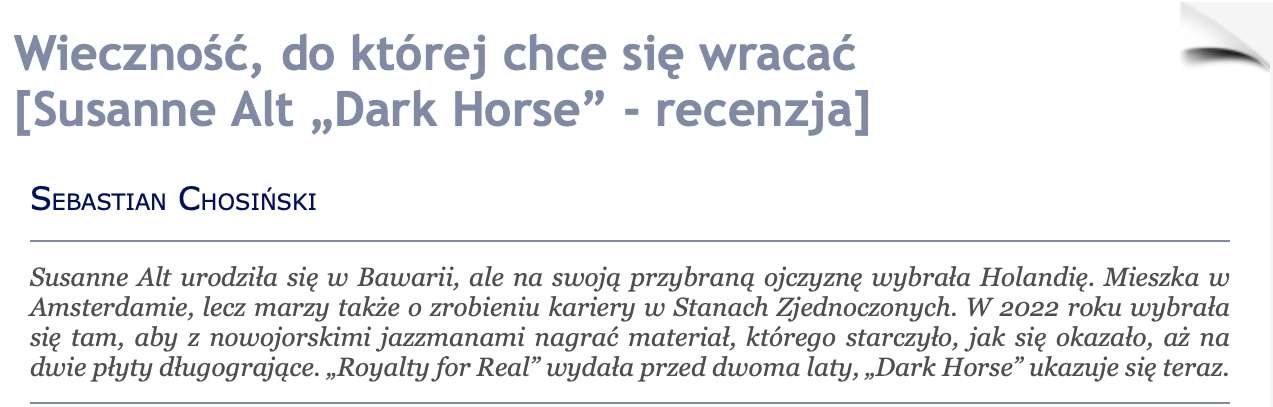
Recording "Royalty for Real" and "Dark Horse", the Gema returned to playing in the quartet. Apparently, such a formula suits her best. It should be emphasized, however, that an intimate composition does not mean intimate music at all. Susanne and James took care of the arrangement wealth of the recordings. Alt played three types of saxophones (although tenor and soprano can only be heard in one final composition, but always), flute and percussion; in turn, Hurt reached for organs, acoustic and electric pianos (legendary Rhodes piano) and synthesizers. This simply translates into sophistication of sounds. And it makes the album stylistically unfastened between be- and post-bop and funk, fusion elements, ba! even psychedelia.
Susanne throws "Jazz Biotic" at the first fire. A number from the first seconds emanating funk-soul energy, which is added by the dynamic part of the leader's alto saxophone and Hurt's "acid" organs. The most important, however, is the "black" pulse of the rhythm section, against the background of which James eventually allows himself to make a pianistic improvisation, which is an interlude between his duets with Alt. The saxophonist only frees herself from the leash at the end, as a result of which we are given a solo full of sphandage. In "Altitudes of Freedom" the band slows down a bit. The leading narrative, which is repeated later in subsequent songs, is led by the leader; in the background she is accompanied by other instrumentalists, among whom only the keyboardist experiences the honor of solo show, this time using a synthesizer.
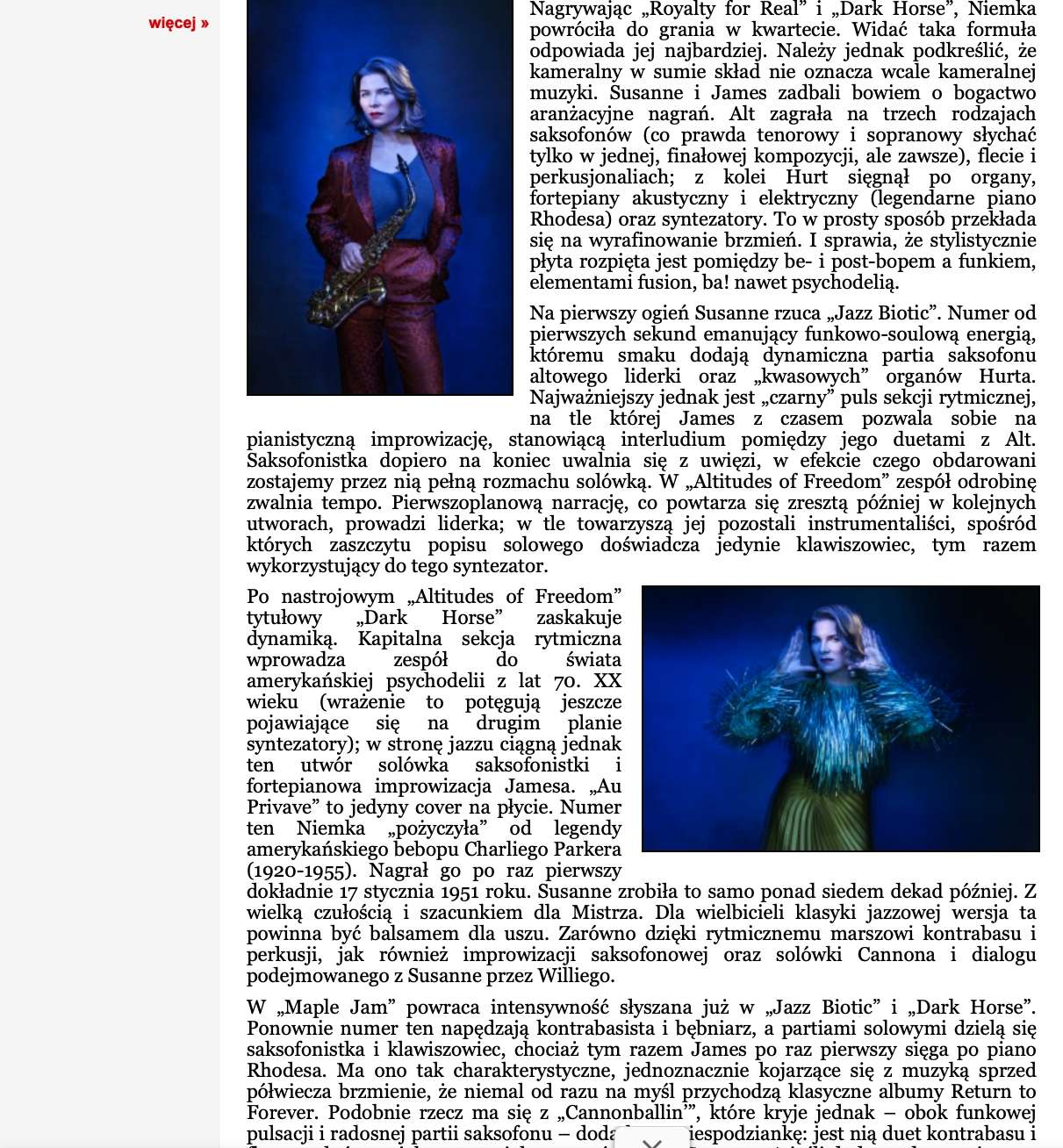
After the atmospheric "Altitudes of Freedom", the title "Dark Horse" surprises with its dynamics. A capital rhythm section introduces the band to the world of American psychedelia from the 1970s. In the 1960s (this impression is enhanced by the synthesizers appearing in the background); however, this piece is drawn to the saxophonist's solo and James' piano improvisation towards jazz. "Au Privave" is the only cover on the album. The Geman "borrowed" this number from the legend of American bebop Charlie Parker (1920-1955). He recorded it for the first time on January 17, 1951. Susanne did the same more than seven decades later. With great tenderness and respect for the Master. For fans of jazz classics, this version should be an ear balm. Both thanks to the rhythmic march of double bass and drums, as well as saxophone improvisation and Cannon's solo and the dialogue with Susanne by Willi.
In "Maple Jam" the intensity already heard in "Jazz Biotic" and "Dark Horse" returns. Again, this number is driven by the double bassist and drummer, and the solo parts are shared by the saxophonist and keyboardist, although this time James reaches for the Rhodes piano for the first time. It has such a distinctive sound, unambiguously associated with the music from half a century ago, that the classic albums Return to Forever almost immediately come to mind. The same goes for "Cannonballin'", which, however, hides - in addition to the funky pulsation and the joyful part of the saxophone - an additional surprise: it is a double bass and flute duo, on which, as I mentioned earlier, Susanne plays. And if we add to this the improvisation of James on Rhodes that resounds in the second part of the composition - we have a full picture of the fruits offered to us by the artists.
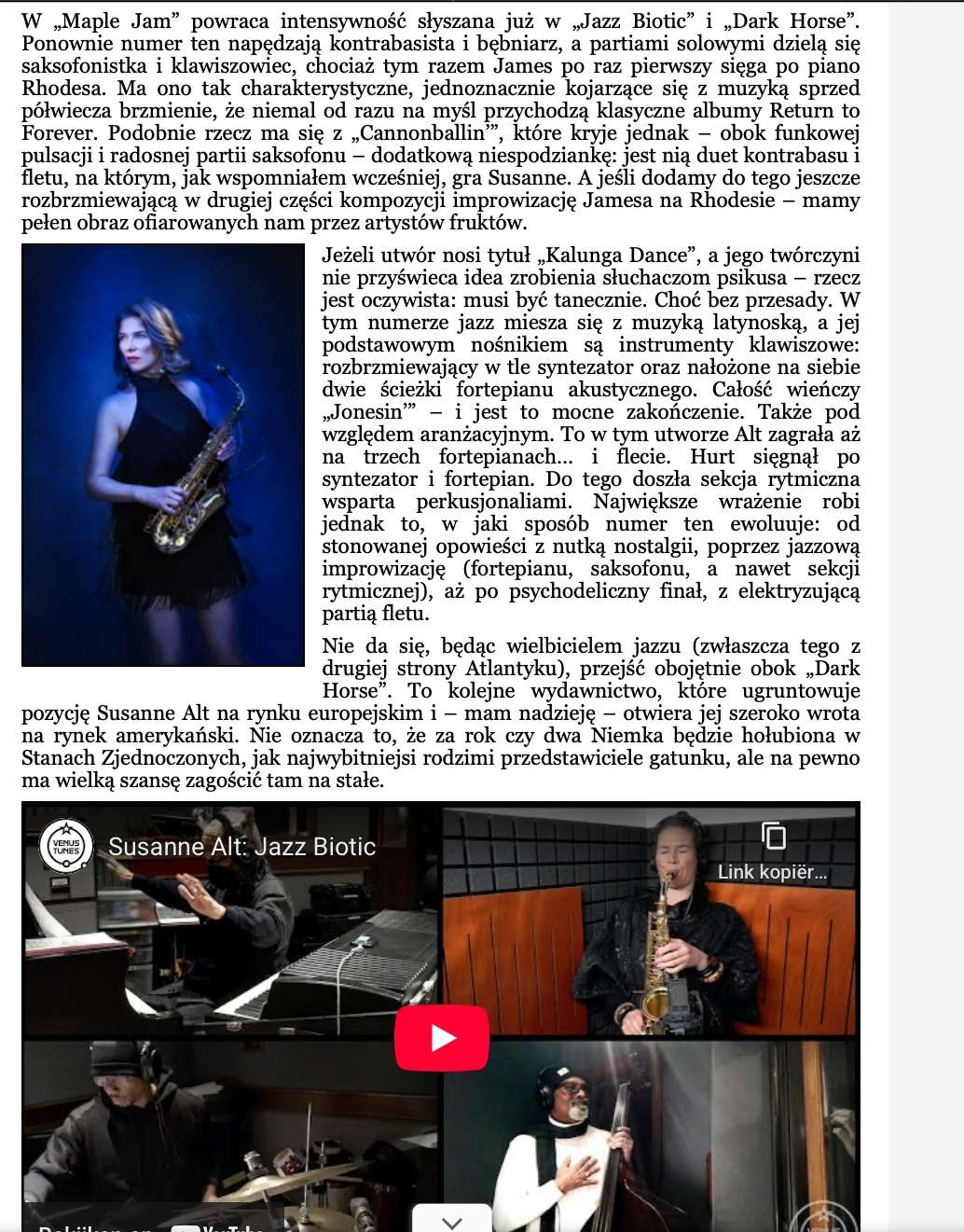
If the song is titled "Kalunga Dance" and its creator is not guided by the idea of playing a prank on the audience - the thing is obvious: it must be danceable. Although without exaggeration. In this issue, jazz is mixed with Latin music, and its main carrier is keyboard instruments: a synthesizer resounding in the background and two tracks of an acoustic piano superimposed on each other. The whole is crowned by "Jonesin'" - and it is a strong ending. Also in terms of arrangement. It was in this piece that Alt played as many as three pianos... and a flute. Hurt reached for a synthesizer and a piano. In addition, there was a rhythm section supported by drums. The most impressive, however, is how this number evolves: from a subdued story with a hint of nostalgia, through jazz improvisation (piano, saxophone, and even a rhythm section), to a psychedelic finale, with an electrifying flute part.
It is impossible, being a fan of jazz (especially the one on the other side of the Atlantic), to pass by "Dark Horse" indifferently. This is another release that consolidates Susanne Alt's position on the European market and - I hope - opens her wide gates to the American market. This does not mean that in a year or two the German will be homished in the United States, like the most outstanding native representatives of the species, but she certainly has a great chance of staying there permanently.
on 29/01/2026
back to top
P8 (Danish radio) - Read more English translation:Susanne Alt was born in Bavaria, but chose Holland as her adopted homeland. He lives in Amsterdam, but also dreams of a career in the United States. In 2022, she went there to record material with New York jazzmen, which turned out to be enough for two full-length albums. Royalty for Real was released two years ago, Dark Horse is now being published.A native of Würzburg in Bavaria, but has been associated with Amsterdam for many years, saxophonist and flutist Susanne Alt is a woman of many talents. Not only an artist who records albums with both aspiring musicians and modern jazz aces, but also a thriving businesswoman who has been running her own record label - Venus Tunes for over two decades. Thanks to the fact that she is a producer and publisher herself, she has full control over her artistic path. He plays what he wants. And with the ones he wants. Initially, she headed her own Quartet, with which she released four albums (Nocturne, 2004; Delight, 2007; On Track, 2009; concert Live at Bimhuis, 2011). Others, like How to Kiss (2012) or Saxify (2016), she signed only with her own name. The same happened with the materials that she recorded after several years of silence during the expedition to the other side of the Atlantic.In her music, Alt never shied away from inspiration from the classics of American jazz. No wonder, then, that one of her dreams was to record an album in the United States. And not with unnamed craftsmen, but artists whose achievements are dizzying. She therefore invited keyboardist James Hurt (who has, among others, a collaboration with saxophonist Abraham Burton, trumpeter Duane Eubanks, as well as drummers Rashied Ali and Adam Rudolph), double bassist Gerald Cannon (who scrolled through the bands of former Quartet instrumentalists John Coltrane: drummer Elvin Jones and pianist McCoy Tyner) and drummer Willie Jones III (not suspecting him of dementia at all, I bet the dollars against nuts that he was not able to mention even half of the albums in which he took an active part).With these three, on February 15 and 16, 2022, Susanne locked herself in the prestigious New York studio EastSide Sound to record material, which exactly - as for the day - appeared on the longplay Royalty for Real two years later. However, as it turned out, during this two-day session, Alt, Hurt, Cannon and Jones III recorded much more music. Only that it was enough for her second album, for the publication of which, however, we had to wait another two years - Dark Horse. Interestingly, a similar procedure was used by Alt's colleague, Danish saxophonist Cecilie Strange, who in one day (August 22, 2022) also recorded so much music that it was enough for two more releases: Beyond (2023) and Beech (2025). Nothing expensive about it, of course, because at the very end it's quality that counts, and this one - in the case of both ladies - is impeccable. Recording Royalty for Real and Dark Horse, the Gema returned to playing in the quartet. Apparently, such a formula suits her best. It should be emphasized, however, that an intimate composition does not mean intimate music at all. Susanne and James took care of the arrangement wealth of the recordings. Alt played three types of saxophones (although tenor and soprano can only be heard in one final composition, but always), flute and percussion; in turn, Hurt reached for organs, acoustic and electric pianos (legendary Rhodes piano) and synthesizers. This simply translates into sophistication of sounds. And it makes the album stylistically unfastened between be- and post-bop and funk, fusion elements, ba! even psychedelia.Susanne throws Jazz Biotic at the first fire. A number from the first seconds emanating funk-soul energy, which is added by the dynamic part of the leader's alto saxophone and Hurt's acid organs. The most important, however, is the black pulse of the rhythm section, against the background of which James eventually allows himself to make a pianistic improvisation, which is an interlude between his duets with Alt. The saxophonist only frees herself from the leash at the end, as a result of which we are given a solo full of sphandage. In Altitudes of Freedom the band slows down a bit. The leading narrative, which is repeated later in subsequent songs, is led by the leader; in the background she is accompanied by other instrumentalists, among whom only the keyboardist experiences the honor of solo show, this time using a synthesizer.After the atmospheric Altitudes of Freedom, the title Dark Horse surprises with its dynamics. A capital rhythm section introduces the band to the world of American psychedelia from the 1970s. In the 1960s (this impression is enhanced by the synthesizers appearing in the background); however, this piece is drawn to the saxophonist's solo and James' piano improvisation towards jazz. Au Privave is the only cover on the album. The Geman borrowed this number from the legend of American bebop Charlie Parker (1920-1955). He recorded it for the first time on January 17, 1951. Susanne did the same more than seven decades later. With great tenderness and respect for the Master. For fans of jazz classics, this version should be an ear balm. Both thanks to the rhythmic march of double bass and drums, as well as saxophone improvisation and Cannon's solo and the dialogue with Susanne by Willi.In Maple Jam the intensity already heard in Jazz Biotic and Dark Horse returns. Again, this number is driven by the double bassist and drummer, and the solo parts are shared by the saxophonist and keyboardist, although this time James reaches for the Rhodes piano for the first time. It has such a distinctive sound, unambiguously associated with the music from half a century ago, that the classic albums Return to Forever almost immediately come to mind. The same goes for Cannonballin', which, however, hides - in addition to the funky pulsation and the joyful part of the saxophone - an additional surprise: it is a double bass and flute duo, on which, as I mentioned earlier, Susanne plays. And if we add to this the improvisation of James on Rhodes that resounds in the second part of the composition - we have a full picture of the fruits offered to us by the artists.If the song is titled Kalunga Dance and its creator is not guided by the idea of playing a prank on the audience - the thing is obvious: it must be danceable. Although without exaggeration. In this issue, jazz is mixed with Latin music, and its main carrier is keyboard instruments: a synthesizer resounding in the background and two tracks of an acoustic piano superimposed on each other. The whole is crowned by Jonesin' - and it is a strong ending. Also in terms of arrangement. It was in this piece that Alt played as many as three pianos... and a flute. Hurt reached for a synthesizer and a piano. In addition, there was a rhythm section supported by drums. The most impressive, however, is how this number evolves: from a subdued story with a hint of nostalgia, through jazz improvisation (piano, saxophone, and even a rhythm section), to a psychedelic finale, with an electrifying flute part.It is impossible, being a fan of jazz (especially the one on the other side of the Atlantic), to pass by Dark Horse indifferently. This is another release that consolidates Susanne Alt's position on the European market and - I hope - opens her wide gates to the American market. This does not mean that in a year or two the German will be homished in the United States, like the most outstanding native representatives of the species, but she certainly has a great chance of staying there permanently.